A Short History of Nearly Everything
Subjects, Bill Bryson
A Short History of Nearly Everything Bill Bryson pdf francais - A Short History of Nearly Everything est le grand livre que vous voulez. Ce beau livre est créé par Bill Bryson. En fait, le livre a 692 pages. The A Short History of Nearly Everything est libéré par la fabrication de Transworld Digital. Vous pouvez consulter en ligne avec A Short History of Nearly Everything étape facile. Toutefois, si vous désirez garder pour ordinateur portable, vous pouvez A Short History of Nearly Everything sauver maintenant.. Si vous avez décidé de trouver ou lire ce livre, ci-dessous sont des informations sur le détail de A Short History of Nearly Everything pour votre référence.
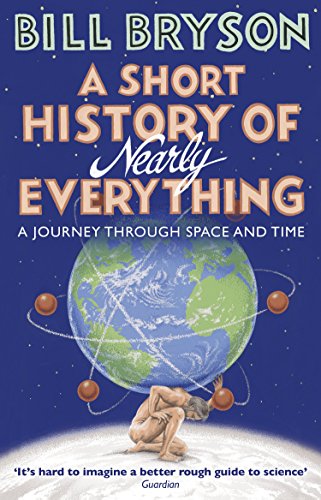
de Bill Bryson
4.2 étoiles sur 5 (595 Commentaires client)
Nom de fichier : a-short-history-of-nearly-everything.pdf
La taille du fichier : 29.87 MB
The ultimate eye-opening journey through time and space, A Short History of Nearly Everything is the biggest-selling popular science book of the 21st century, and reveals the world in a way most of us have never seen it before.What on earth is Bill Bryson doing writing a book of popular science--A Short History of Almost Everything? Largely, it appears, because this inquisitive, much-travelled writer realised, while flying over the Pacific, that he was entirely ignorant of the processes that created, populated and continue to maintain the vast body of water beneath him.
In fact, it dawned on him that "I didn't know the first thing about the only planet I was ever going to live on". The questions multiplied: What is a quark? How can anybody know how much the Earth weighs? How can astrophysicists (or whoever) claim to describe what happened in the first gazillionth of a nanosecond after the Big Bang? Why can't earthquakes be predicted? What makes evolution more plausible than any other theory? In the end, all these boiled down to a single question--how do scientists do science? To this subject Bryson devoted three years of his life, reading books and journals and pestering the people who know (or at least argue about it); and we non-scientists should be pretty grateful to him for passing his findings on to us.
Broadly, his investigations deal with seven topics, all of enormous interest and significance: the origins of the universe; the gradual historical discovery of the size and age of the earth (and the beginnings of the awesome notion of deep time); relativity and quantum theory; the present and future threats to life and the planet; the origins and history of life (dinosaurs, mass extinctions and all); and the evolution of man. Within each of these, he looks at the history of the subject, its development into a modern discipline and the frameworks of theory that now support it. This is a pretty broad brief (life, the universe and everything, in fact), and it's a mark of Bryson's skill that he is able to carve a clear path through the thickets of theory and controversy that infest all these disciplines, all the while maintaining a cracking pace and a fairly judicious tone without obvious longueurs or signs of haste. Even readers fairly familiar with some or all of these areas of discourse are likely to learn from A Short History. If not, they will at least be amused--the tone throughout is agreeable, mingling genuine awe with a mild facetiousness that often rises to wit.
One compelling theme that appears again and again is the utter unpredictability of the universe, despite all that we think we know about it. Nervous page-turners may care to omit the sensational chapters on the possible ways in which it all might end in disaster--Bryson enumerates with cheerful relish the kind of event that makes you want to climb under the bedclothes: undetectable asteroid colliding with the earth; superheated magma chamber erupting in your back garden; ebola carrier getting off a plane in London or New York; the HIV virus mutating to prevent its destruction in the mosquito's digestive system. Indeed, the chief theme of this sprightly book is the miraculous unlikeliness, in a universe ruled by randomness, of stability and equilibrium--of which one result is ourselves and the complex, fragile planet we inhabit. --Robin DavidsonFrom primordial nothingness to this very moment, A Short History of Nearly Everything reports what happened and how humans figured it out. To accomplish this daunting literary task, Bill Bryson uses hundreds of sources, from popular science books to interviews with luminaries in various fields. His aim is to help people like him, who rejected stale school textbooks and dry explanations, to appreciate how we have used science to understand the smallest particles and the unimaginably vast expanses of space. With his distinctive prose style and wit, Bryson succeeds admirably. Though A Short History clocks in at a daunting 500-plus pages and covers the same material as every science book before it, it reads something like a particularly detailed novel (albeit without a plot). Each longish chapter is devoted to a topic like the age of our planet or how cells work, and these chapters are grouped into larger sections such as "The Size of the Earth" and "Life Itself." Bryson chats with experts like Richard Fortey (author of Life and Trilobite) and these interviews are charming. But it's when Bryson dives into some of science's best and most embarrassing fights--Cope vs. Marsh, Conway Morris vs. Gould--that he finds literary gold. --Therese LittletonBill Bryson describes himself as a reluctant traveller, but even when he stays safely at home he can't contain his curiosity about the world around him. A Short History of Nearly Everything is his quest to understand everything that has happened from the Big Bang to the rise of civilization - how we got from there, being nothing at all, to here, being us. Bill Bryson's challenge is to take subjects that normally bore the pants off most of us, like geology, chemistry and particle physics, and see if there isn't some way to render them comprehensible to people who have never thought they could be interested in science.
The ultimate eye-opening journey through time and space, A Short History of Nearly Everything is the biggest-selling popular science book of the 21st century, and reveals the world in a way most of us have never seen it before.Rang parmi les ventes Amazon: #48555 dans eBooksPublié le: 2010-01-23Sorti le: 2010-03-02Format: Ebook KindlePrésentation de l'éditeurBill Bryson describes himself as a reluctant traveller, but even when he stays safely at home he can't contain his curiosity about the world around him. A Short History of Nearly Everything is his quest to understand everything that has happened from the Big Bang to the rise of civilization - how we got from there, being nothing at all, to here, being us. Bill Bryson's challenge is to take subjects that normally bore the pants off most of us, like geology, chemistry and particle physics, and see if there isn't some way to render them comprehensible to people who have never thought they could be interested in science.The ultimate eye-opening journey through time and space, A Short History of Nearly Everything is the biggest-selling popular science book of the 21st century, and reveals the world in a way most of us have never seen it before.Amazon.comFrom primordial nothingness to this very moment, A Short History of Nearly Everything reports what happened and how humans figured it out. To accomplish this daunting literary task, Bill Bryson uses hundreds of sources, from popular science books to interviews with luminaries in various fields. His aim is to help people like him, who rejected stale school textbooks and dry explanations, to appreciate how we have used science to understand the smallest particles and the unimaginably vast expanses of space. With his distinctive prose style and wit, Bryson succeeds admirably. Though A Short History clocks in at a daunting 500-plus pages and covers the same material as every science book before it, it reads something like a particularly detailed novel (albeit without a plot). Each longish chapter is devoted to a topic like the age of our planet or how cells work, and these chapters are grouped into larger sections such as "The Size of the Earth" and "Life Itself." Bryson chats with experts like Richard Fortey (author of Life and Trilobite) and these interviews are charming. But it's when Bryson dives into some of science's best and most embarrassing fights--Cope vs. Marsh, Conway Morris vs. Gould--that he finds literary gold. --Therese LittletonExtrait1 HOW TO BUILD A UNIVERSENO MATTER HOW hard you try you will never be able to grasp just how tiny, how spatially unassuming, is a proton. It is just way too small.A proton is an infinitesimal part of an atom, which is itself of course an insubstantial thing. Protons are so small that a little dib of ink like the dot on this i can hold something in the region of 500,000,000,000 of them, rather more than the number of seconds contained in half a million years. So protons are exceedingly microscopic, to say the very least.Now imagine if you can (and of course you can't) shrinking one of those protons down to a billionth of its normal size into a space so small that it would make a proton look enormous. Now pack into that tiny, tiny space about an ounce of matter. Excellent. You are ready to start a universe.I'm assuming of course that you wish to build an inflationary universe. If you'd prefer instead to build a more old-fashioned, standard Big Bang universe, you'll need additional materials. In fact, you will need to gather up everything there is--every last mote and particle of matter between here and the edge of creation--and squeeze it into a spot so infinitesimally compact that it has no dimensions at all. It is known as a singularity.In either case, get ready for a really big bang. Naturally, you will wish to retire to a safe place to observe the spectacle. Unfortunately, there is nowhere to retire to because outside the singularity there is no where. When the universe begins to expand, it won't be spreading out to fill a larger emptiness. The only space that exists is the space it creates as it goes.It is natural but wrong to visualize the singularity as a kind of pregnant dot hanging in a dark, boundless void. But there is no space, no darkness. The singularity has no "around" around it. There is no space for it to occupy, no place for it to be. We can't even ask how long it has been there--whether it has just lately popped into being, like a good idea, or whether it has been there forever, quietly awaiting the right moment. Time doesn't exist. There is no past for it to emerge from.And so, from nothing, our universe begins.In a single blinding pulse, a moment of glory much too swift and expansive for any form of words, the singularity assumes heavenly dimensions, space beyond conception. In the first lively second (a second that many cosmologists will devote careers to shaving into ever-finer wafers) is produced gravity and the other forces that govern physics. In less than a minute the universe is a million billion miles across and growing fast. There is a lot of heat now, ten billion degrees of it, enough to begin the nuclear reactions that create the lighter elements--principally hydrogen and helium, with a dash (about one atom in a hundred million) of lithium. In three minutes, 98 percent of all the matter there is or will ever be has been produced. We have a universe. It is a place of the most wondrous and gratifying possibility, and beautiful, too. And it was all done in about the time it takes to make a sandwich.When this moment happened is a matter of some debate. Cosmologists have long argued over whether the moment of creation was 10 billion years ago or twice that or something in between. The consensus seems to be heading for a figure of about 13.7 billion years, but these things are notoriously difficult to measure, as we shall see further on. All that can really be said is that at some indeterminate point in the very distant past, for reasons unknown, there came the moment known to science as t = 0. We were on our way.There is of course a great deal we don't know, and much of what we think we know we haven't known, or thought we've known, for long. Even the notion of the Big Bang is quite a recent one. The idea had been kicking around since the 1920s, when Georges Lem tre, a Belgian priest-scholar, first tentatively proposed it, but it didn't really become an active notion in cosmology until the mid-1960s when two young radio astronomers made an extraordinary and inadvertent discovery.Their names were Arno Penzias and Robert Wilson. In 1965, they were trying to make use of a large communications antenna owned by Bell Laboratories at Holmdel, New Jersey, but they were troubled by a persistent background noise--a steady, steamy hiss that made any experimental work impossible. The noise was unrelenting and unfocused. It came from every point in the sky, day and night, through every season. For a year the young astronomers did everything they could think of to track down and eliminate the noise. They tested every electrical system. They rebuilt instruments, checked circuits, wiggled wires, dusted plugs. They climbed into the dish and placed duct tape over every seam and rivet. They climbed back into the dish with brooms and scrubbing brushes and carefully swept it clean of what they referred to in a later paper as "white dielectric material," or what is known more commonly as bird shit. Nothing they tried worked.Unknown to them, just thirty miles away at Princeton University, a team of scientists led by Robert Dicke was working on how to find the very thing they were trying so diligently to get rid of. The Princeton researchers were pursuing an idea that had been suggested in the 1940s by the Russian-born astrophysicist George Gamow that if you looked deep enough into space you should find some cosmic background radiation left over from the Big Bang. Gamow calculated that by the time it crossed the vastness of the cosmos, the radiation would reach Earth in the form of microwaves. In a more recent paper he had even suggested an instrument that might do the job: the Bell antenna at Holmdel. Unfortunately, neither Penzias and Wilson, nor any of the Princeton team, had read Gamow's paper.The noise that Penzias and Wilson were hearing was, of course, the noise that Gamow had postulated. They had found the edge of the universe, or at least the visible part of it, 90 billion trillion miles away. They were "seeing" the first photons--the most ancient light in the universe--though time and distance had converted them to microwaves, just as Gamow had predicted. In his book The Inflationary Universe, Alan Guth provides an analogy that helps to put this finding in perspective. If you think of peering into the depths of the universe as like looking down from the hundredth floor of the Empire State Building (with the hundredth floor representing now and street level representing the moment of the Big Bang), at the time of Wilson and Penzias's discovery the most distant galaxies anyone had ever detected were on about the sixtieth floor, and the most distant things--quasars--were on about the twentieth. Penzias and Wilson's finding pushed our acquaintance with the visible universe to within half an inch of the sidewalk.Still unaware of what caused the noise, Wilson and Penzias phoned Dicke at Princeton and described their problem to him in the hope that he might suggest a solution. Dicke realized at once what the two young men had found. "Well, boys, we've just been scooped," he told his colleagues as he hung up the phone.Soon afterward the Astrophysical Journal published two articles: one by Penzias and Wilson describing their experience with the hiss, the other by Dicke's team explaining its nature. Although Penzias and Wilson had not been looking for cosmic background radiation, didn't know what it was when they had found it, and hadn't described or interpreted its character in any paper, they received the 1978 Nobel Prize in physics. The Princeton researchers got only sympathy. According to Dennis Overbye in Lonely Hearts of the Cosmos, neither Penzias nor Wilson altogether understood the significance of what they had found until they read about it in the New York Times.Incidentally, disturbance from cosmic background radiation is something we have all experienced. Tune your television to any channel it doesn't receive, and about 1 percent of the dancing static you see is accounted for by this ancient remnant of the Big Bang. The next time you complain that there is nothing on, remember that you can always watch the birth of the universe.Although everyone calls it the Big Bang, many books caution us not to think of it as an explosion in the conventional sense. It was, rather, a vast, sudden expansion on a whopping scale. So what caused it?One notion is that perhaps the singularity was the relic of an earlier, collapsed universe--that we're just one of an eternal cycle of expanding and collapsing universes, like the bladder on an oxygen machine. Others attribute the Big Bang to what they call "a false vacuum" or "a scalar field" or "vacuum energy"--some quality or thing, at any rate, that introduced a measure of instability into the nothingness that was. It seems impossible that you could get something from nothing, but the fact that once there was nothing and now there is a universe is evident proof that you can. It may be that our universe is merely part of many larger universes, some in different dimensions, and that Big Bangs are going on all the time all over the place. Or it may be that space and time had some other forms altogether before the Big Bang--forms too alien for us to imagine--and that the Big Bang represents some sort of transition phase, where the universe went from a form we can't understand to one we almost can. "These are very close to religious questions," Dr. Andrei Linde, a cosmologist at Stanford, told the New York Times in 2001.The Big Bang theory isn't about the bang itself but about what happened after the bang. Not long after, mind you. By doing a lot of math and watching carefully what goes on in particle accelerators, scientists believe they can look back to 10-43 seconds after the moment of creation, when the universe was still so small that you would have needed a microscope to find it. We mustn't swoon over every extraordinary number that comes before us, but it is perhaps worth l...Vous trouverez ci-dessous les commentaires du lecteur après avoir lu A Short History of Nearly Everything. Vous pouvez considérer pour votre référence.
0 internautes sur 0 ont trouvé ce commentaire utile.Excellent book I recommending to all ..,,Par Client d'AmazonExcellent book, A nicely explained the science and human history please read this book it can change ur life and your views the world ....
Si vous avez un intérêt pour A Short History of Nearly Everything, vous pouvez également lire un livre similaire tel que cc Down Under: Travels in a Sunburned Country, Neither Here, Nor There: Travels in Europe, The Lost Continent: Travels in Small-Town America, At Home: A Short History of Private Life, The Mother Tongue: English and How it Got that Way, A Walk In The Woods: The World's Funniest Travel Writer Takes a Hike, Made In America: An Informal History of American English, Notes From A Small Island: Journey Through Britain, The Road to Little Dribbling: More Notes from a Small Island, Bill Bryson's African Diary
0 komentar:
Posting Komentar